
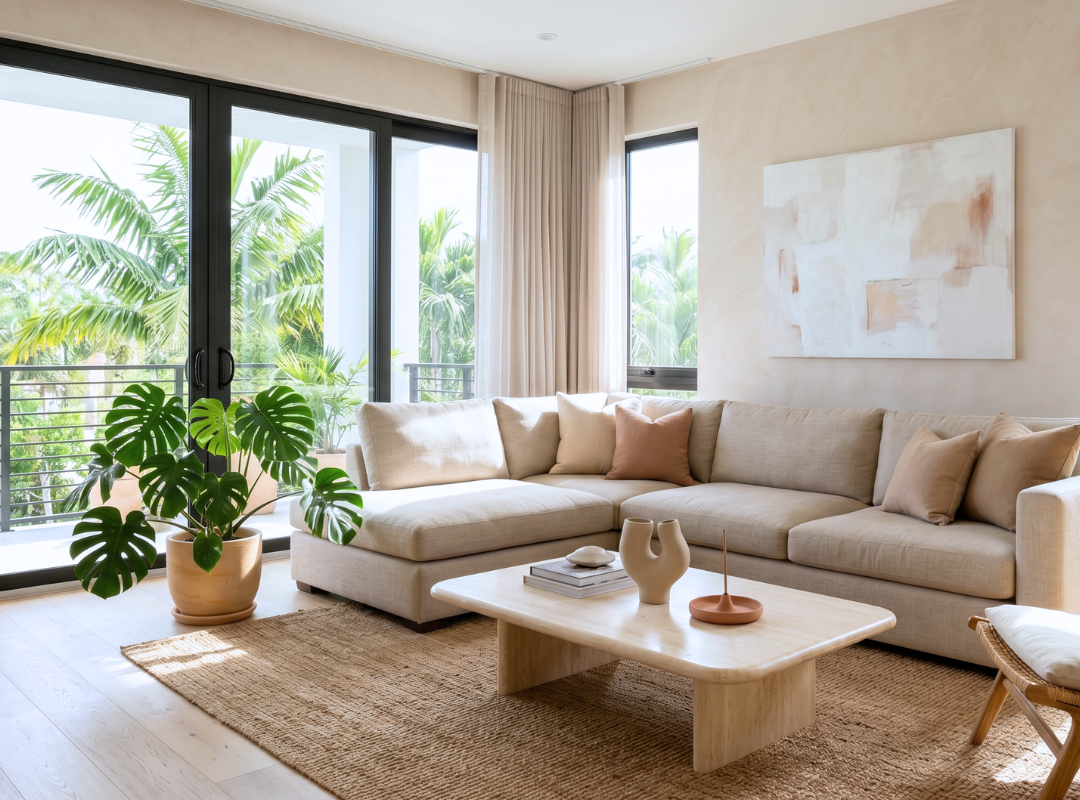
Modern Organic Home Décor | How to Bring It to Life in a Florida Home
Modern organic home décor is a design style that combines the clean lines of contemporary interiors with natural materials, warm textures, and a connection to the living world. In Florida homes, where the boundary between indoors and outdoors is deliberately blurred, this style is not just on-trend — it is a natural fit for the climate, the light, and the way Floridians actually live.
Get the material selection right and the space comes alive. Get it wrong and it reads like a collection of trending objects rather than a considered interior. Here is how to do it properly in a Florida home.
What Is Modern Organic Home Décor and What Makes It Different?
Modern organic home décor is the practice of designing a space using natural materials, muted earth tones, and textures drawn from the natural world — while keeping the overall aesthetic clean, uncluttered, and contemporary. It is different from traditional rustic or farmhouse style because it avoids the heavy, rough-hewn feel. Everything is refined and intentional.
The key materials in organic modern design are linen, jute, rattan, raw wood, natural stone, terracotta, and unbleached cotton. The palette runs through warm sand, clay, sage, warm white, and mushroom. The result is a space that feels calm, grounded, and alive — without a single piece of fussy or decorative clutter.
I see this style landing particularly well in Central Florida homes, where the light is warm and abundant and the indoor-outdoor connection is built into the architecture. The organic palette does not fight Florida’s natural light — it complements it.
For a deeper look at how this works in Florida architecture, read our guide on biophilic design for Florida homes.
Which Natural Materials Work Best for an Organic Modern Interior?
The materials that define organic modern interiors are the ones that age well, breathe in Florida’s humidity, and bring genuine texture into a room. Raw linen upholstery is the workhorse of this style — it is cooler than polyester blends, it drapes beautifully, and it photographs well in the kind of warm Florida light that fills living rooms in the afternoon.
For hard surfaces, look at unsealed travertine, honed marble, and raw-edge wood furniture. Rattan and woven seagrass work for accent chairs, pendants, and storage — they add visual warmth without adding visual noise. Terracotta pots and ceramic vessels bring the organic palette to countertops, shelves, and lanai spaces.
What to avoid: synthetic finishes masquerading as natural ones. A high-gloss laminate that mimics wood grain will undermine the whole room. If you are investing in organic modern design, invest in the actual materials — even in small quantities.
For a full overview of material choices, read our guide to best sustainable materials for interiors 2025.
How Do You Choose the Right Colour Palette for Organic Modern Décor?
The colour palette for organic modern home décor is warm, muted, and drawn from nature — not from a paint chart. Think sand, warm stone, aged linen, clay, sage, soft terracotta, and the kind of off-white that has a yellow or green undertone rather than a blue one.
In Florida homes, the key is to choose colours that hold up under intense natural light without washing out or looking harsh. A colour that reads as a soft, warm greige in a showroom can read entirely differently at midday in an east-facing Orlando living room. Always test paint swatches through a full day of light before committing.
The accent rule in organic modern design is straightforward: one warm metal (brushed brass or aged bronze), one natural fibre, and one moment of deep tone — a terracotta cushion, a black ceramic vase, a forest green plant. That is enough. The moment a space has three competing accent colours, it stops reading as organic modern and starts reading as eclectic.
How Do You Layer Textures Without Making a Space Feel Cluttered?
Layering texture in organic modern design is about contrast, not accumulation. You are pairing smooth against rough, matte against sheen, flat against dimensional — not piling up every natural material you can find.
A practical layering sequence for a Florida living room: start with a linen sofa (smooth, structured), add a jute or wool rug (rough, flat), bring in a rattan occasional chair (woven, dimensional), layer with a chunky-knit throw (soft, textured), and finish with ceramic vessels and a trailing plant. Five textures, clearly differentiated, no two competing.
The ceiling is one of the most underused texture opportunities in Florida homes. Exposed wood beams, a limewash finish, or a woven pendant light can lift the whole room without adding floor-level clutter. Work the full vertical space — not just the surfaces at eye level.
Getting the material mix right for Florida’s specific climate and light conditions is something Marilou handles on every project she takes on. The difference between a space that looks organic modern and one that genuinely lives it is in those material decisions — and that is exactly where 30 years of Central Florida design experience pays off.
Ready to bring this to life in your home? Visit Stones Design LLC’s Interior Designer Services or book a free consultation — call Marilou on 407-808-4011.
How Does Organic Modern Décor Work in Florida’s Climate and Architecture?
Florida architecture is ideally suited to organic modern design because both prioritise connection to the outside world. Open floor plans, large windows, lanais and Florida rooms, indoor plants that thrive year-round — all of these are natural expressions of the same design philosophy.
The practical challenge in Florida is humidity. Natural materials need to be chosen carefully for durability in a humid climate. Rattan and seagrass hold up well in Florida’s indoor humidity levels when protected from direct outdoor exposure. Linen and cotton upholstery dry faster than microfibre if they catch spilled water. Solid hardwood is more stable than engineered in air-conditioned spaces — but both need acclimatisation.
The opportunity in Florida is plant life. Organic modern design relies on greenery for its living quality, and Florida’s climate allows for a greater variety of indoor and semi-outdoor plants than almost any other US state. Monstera, bird of paradise, fiddle leaf fig, and pothos all thrive in Florida homes and are foundational plants for this aesthetic.
For year-round plant guidance in this climate, read our guide to indoor plants for Florida humidity.
Frequently Asked Questions About Modern Organic Home Décor
What is modern organic home décor?
Modern organic home décor is a design style that combines clean, contemporary aesthetics with natural materials, warm earth tones, and textures drawn from the natural world. It uses materials such as linen, rattan, raw wood, travertine, and terracotta in a refined, uncluttered way. The result is a space that feels calm and grounded — without the heavy, rustic feel of farmhouse or country styles.
What colours are used in organic modern interior design?
Organic modern interior design uses a warm, muted palette drawn from nature: sand, warm stone, aged linen, clay, sage, soft terracotta, and off-whites with yellow or green undertones. It avoids cool greys, bright whites, and bold primary colours. In Florida homes, these colours are chosen for how they hold up under intense natural light — warm tones perform better than cool ones in sun-filled spaces.
What materials define organic modern design?
The core materials of organic modern design are natural and age well: raw linen, jute, rattan, seagrass, unsealed travertine, honed marble, raw-edge wood, terracotta, unbleached cotton, and ceramic. Brushed brass and aged bronze are the preferred metal finishes. The defining principle is that everything should be genuinely natural — synthetic materials that mimic natural ones undermine the authenticity of the style.
How do I add organic modern décor to a Florida home?
To add organic modern décor to a Florida home, start with the big surfaces: a linen or natural-fibre sofa, a jute or wool rug, and honed stone or wood flooring. Then layer in natural accents — rattan lighting, ceramic vessels, raw-wood shelving, and indoor plants suited to Florida’s humidity (monstera, bird of paradise, and pothos all work well). Keep the palette in warm, muted earth tones and avoid synthetic finishes.
Is organic modern design the same as biophilic design?
Organic modern design and biophilic design overlap but are not the same. Biophilic design is specifically about strengthening the human connection to nature through architecture and space — it includes things like natural light, views of the outdoors, and living walls. Organic modern design is primarily an aesthetic style that uses natural materials and earth tones. A space can be organic modern without being biophilically designed, and a biophilic space does not have to follow the organic modern palette.
Ready to bring modern organic design to life in your Florida home? Stones Design LLC’s
Interior Designer Services cover everything from material sourcing to full room design — Marilou brings 30 years of Central Florida design experience to every single project. Book a free consultation and let’s create a space that genuinely reflects who you are. Call us on 407-808-4011.