
How to Use Tropical Patterns in Florida Interior Design Without Looking Themed
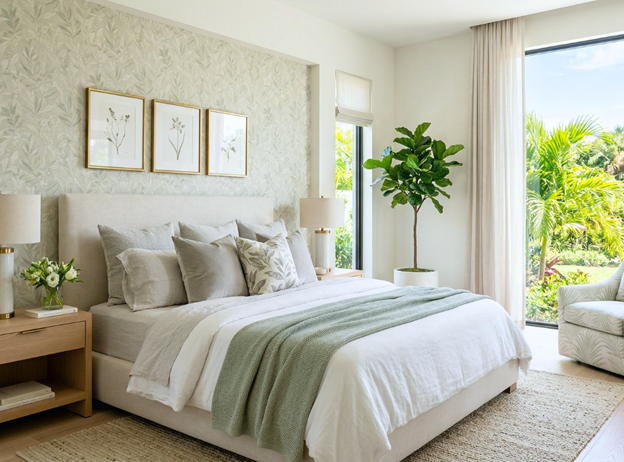
Limit tropical patterns to one statement piece per room—an accent chair, cushions, or a single piece of wall art. Keep the base palette neutral and let the pattern stand out. Use botanical prints in muted greens and navy rather than bright primary colors to maintain a refined, grounded look.
The Florida problem with tropical patterns in interior design
If you live in Central Florida—like many of my clients in Orlando, Winter Garden, and Windermere—you have wondered how to use tropical patterns in Florida interior design without your home feeling like a resort gift shop.
Here is what I see repeatedly: homeowners love palm prints, banana leaves, and botanical motifs—but they layer too many at once. The room starts to feel busy instead of calm. Instead of elevated, tasteful tropical decor, space quickly leans into something overly themed.
In Florida homes, the architecture already does half the work. Large windows, lanai views, and natural light bring the outdoors in. When too many patterns are added, the balance disappears.
The goal is not to avoid tropical patterns—it is to control them.
In more than 30 years of designing living spaces across Central Florida, I have found that one strong pattern creates an impact. Multiple competing prints rarely do.
My approach to botanical print home design in Florida living spaces
When I introduce botanical print home design into a Florida living room, I always begin with restraint and a clear focal point.
I select one feature piece, such as:
- a Thibaut palm-print accent chair
- Schumacher botanical cushions in muted sage
- or a large, framed York Wallcoverings panel in navy and leaf green
Then I let everything else stay quiet.
In a well-balanced Florida home pattern design, my base palette typically includes Benjamin Moore White Dove walls, light oak flooring like Provenza Moda Living, and textured neutral upholstery from Kravet or Sunbrella.
Sunbrella is especially valuable in Florida interiors—humidity and UV exposure can break down lower-quality textiles faster than most homeowners expect.
I also avoid overly bright greens and novelty-style prints unless we are designing a casual outdoor space. Inside the main living areas, I lean into olive, eucalyptus, navy, and dusty teal. These tones are refined and architectural.
That is what transforms bold prints into tasteful tropical decor that feels intentional rather than decorative.
Another rule I always follow scale matters more than color. One oversized botanical motif feels curated. Multiple small repeats feel cluttered.
Where this works best in Florida interiors
Across dozens of homes, I have designed—from Horizon West to Clermont—I see the same pattern.
Clients often come in with multiple tropical pieces already purchased: pillows, rugs, curtains, and artwork. Individually, they are beautiful. Together, they compete.
When I simplify the space to one dominant botanical element, everything shifts.
A navy banana-leaf chair becomes sculptural.
A framed palm study reads like art.
A single accent pillow adds personality without overwhelming the room.
This is the difference between decorative styling and a strategic Florida home pattern design approach.
In open-concept layouts—common throughout Orlando homes—these matters even more. Sightlines flow from one space to another, so repeated patterns can quickly make the entire home feel themed.
When placement is intentional, the result feels calm, coastal, and unmistakably in Florida—without trying too hard.
What you can do right now for tasteful tropical decor
If you want to elevate your space today, start with one room and one decision.
Choose a single botanical feature:
- Serena & Lily Montecito pillow
- Schumacher Chiang Mai Dragon in muted tones
- Thibaut Tropics print upholstery
- York Wallcoverings botanical panel art
Then remove any competing prints nearby.
Next, layer in texture instead of more patterns. This is where most homeowners get it wrong.
I recommend:
- woven grass cloth wallpaper from Phillip Jeffries
- a Palecek rattan side table
- or a Visual Comfort ceramic lamp
Texture supports tasteful tropical decor without adding visual noise.
Lighting also plays a key role. Florida sunlight intensifies color, which means a fabric that looks subtle in a showroom may feel overpowering in your home—especially in west-facing rooms.
That is why I always test materials in the actual space before finalizing a design direction.
From a budget perspective, a single high-quality botanical accent—ranging from $150 to $1,200—will always outperform multiple lower-cost pieces competing for attention.
That is the foundation of a successful tropical pattern strategy in Florida interiors.
Related design considerations
Whenever I incorporate tropical elements into a space, I also evaluate the material mix.
Natural wood, stone, linen, and ceramics help botanical patterns feel grounded and authentic. Without these, even the best print can feel disconnected.
Undertones matter just as much. If your walls are warm but your fabrics lean cool, the entire room can feel slightly off. Alignment is key to making botanical print home design feel cohesive.
And in homes with indoor-outdoor flow—which is most Florida—coordinating interior accents with exterior landscaping creates a seamless visual transition.
These are the details that elevate a space from styled to designed.
If your space already includes tropical elements but still does not feel quite right, it usually comes down to editing—not starting over.
Send me a photo of your room, and I will help you refine it, so your tropical pattern choices feel balanced, elevated, and perfectly suited to your Florida interior:
https://www.stonesdesignllc.com/contact/
FAQs
How many tropical patterns should I use in one Florida living room?
Limit tropical patterns in Florida interior styling to one dominant statement piece. Natural light amplifies contrast, so multiple prints can feel overwhelming.
What colors make botanical print home design look sophisticated in Florida homes?
Muted greens, navy, eucalyptus, and dusty teal consistently create a more refined look than bright, high-contrast tropical tones.
Can tropical patterns work in small Florida interiors, like Orlando homes?
Yes. In smaller spaces, one oversized botanical element creates more impact than several small patterns.
Is tasteful tropical decor appropriate for modern Florida interiors?
Absolutely. When paired with neutral materials, clean lines, and natural textures, tropical prints feel architectural—not decorative.
Why trust your advice on Florida home pattern design?
With more than 30 years of experience designing interiors across Central Florida, my approach is based on real-world application—not showroom trends.
By Marilou Stones — Award-winning Interior Designer, Orlando FL. Best Interior Designer — Winter Garden Magazine 2024. Good Stuff Awards 2024. Contributing designer on the 2025 Parade of Homes Realtors’ Favorite home (builder team recognition).