
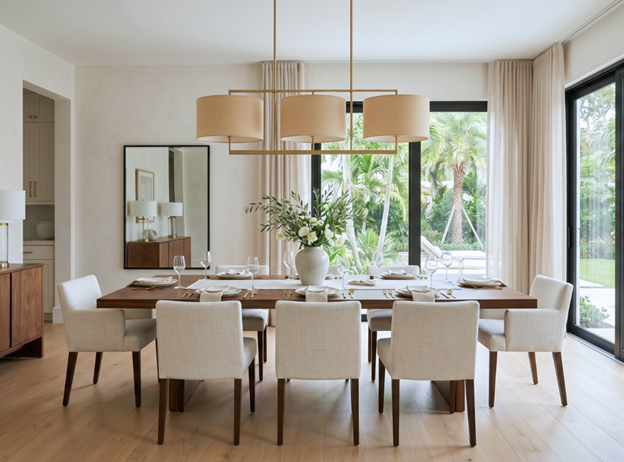
Light Fitting Dining Room | How to Choose the Right One for Your Florida Home
The right light fitting in a dining room does three jobs at once: it sets the mood, defines the space, and reflects your personal style. In Florida homes, where natural light is abundant but evening ambiance matters, choosing the right dining room light fitting means balancing scale, warmth, and practicality — all before a single screw goes in the wall.
Get this decision right and the whole room comes together. Get it wrong and no amount of great furniture will compensate for a fixture that is too small, hung too high, or jarring against everything else.
What Kind of Light Fitting Works Best in a Dining Room?
A pendant light or chandelier positioned directly over the dining table is the most effective light fitting for a dining room. The fixture anchors the space visually, draws the eye to the table, and creates a focal point that makes the room feel intentional.
For Florida homes, open and airy designs — rattan, brushed nickel, or linen shades — tend to work better than heavy crystal chandeliers, which can feel out of place in a light-filled, relaxed interior. The key is choosing a fixture whose weight and material match the overall mood of your dining space.
I’ve seen homeowners fall in love with a chandelier online, hang it in their Orlando dining room, and feel deflated when it looks wrong. Scale and material context are everything. For more on this, read dining room lighting tips from Orlando designers.
How High Should a Dining Room Light Fitting Hang?
Your dining room light fitting should hang 30 to 36 inches above the tabletop. This height creates a pool of warm, flattering light over the table without blocking sightlines across it.
In rooms with higher ceilings — common in newer Florida builds — you can adjust upward, but the 30–36 inch rule is the starting point. Going too high diffuses the light and loses the intimacy. Going too low creates a physical obstruction and makes the room feel cramped.
Most pendant fittings come with adjustable cord or rod lengths. Always adjust before installing permanently. If you are using a hard-wired chandelier with a fixed drop, calculate the chain length carefully before the electrician sets it.
What Size Light Fitting Do You Need for a Dining Room?
The diameter of your dining room light fitting should be approximately 12 inches less than the width of your dining table. A 48-inch-wide table calls for a 36-inch pendant or chandelier.
For rectangular tables, consider a linear pendant or two pendants in a row rather than a single circular fixture — it gives better spread and looks more deliberate. Oversizing is the most common mistake Florida homeowners make when choosing a dining fixture.
There is also a ceiling-based rule: add the room’s length and width in feet and convert to inches — that figure gives you the approximate fixture diameter for the space. A 12 x 14 ft dining room calls for a fixture around 26 inches wide. For more ideas on this, see dining room light fitting ideas for Florida homes.
Which Style of Dining Room Light Fitting Suits a Florida Home?
Florida interiors favour light fittings that feel relaxed, open, and connected to the outdoors. Rattan and woven pendants bring a coastal warmth without being overtly beachy. Brushed brass or aged bronze metalwork adds depth without heaviness.
For modern transitional spaces — the most common interior style across Central Florida — a simple drum shade or a globe pendant in soft white or smoked glass hits the right note. Avoid ultra-contemporary minimalist fixtures if your space has warm undertones — the contrast rarely works.
The finish of your fitting should tell the same story as the rest of the room. If your cabinetry has warm undertones, go warm metal. If your space is cooler and more neutral, brushed nickel or matte black gives definition without disrupting the balance.
This is exactly where working with an experienced interior designer pays off. At Stones Design LLC, Marilou assesses your dining space, your ceiling height, your table dimensions, and your overall design palette — then recommends the right fitting with confidence. Ready to get started? Visit our
Interior Designer Services page or book a free consultation — call us on 407-808-4011.
Does a Dining Room Need a Dimmer Switch for the Light Fitting?
Yes — a dimmer switch is essential for any dining room light fitting. Fixed-brightness fixtures are almost always either too bright for evening dining or too dim for practical use. A dimmer lets you move from full task lighting when setting the table to soft, flattering ambiance during dinner.
In Florida, where indoor-outdoor entertaining is common, a dimmable dining room fixture makes the transition from day to evening seamless. Always confirm that your chosen light fitting is dimmer-compatible before purchase — some LEDs and older fittings do not play well with standard dimmer switches.
For a practical walkthrough of how to choose a fitting that works for your exact space, read our guide on how to choose the perfect light fitting for your dining room makeover.
Frequently Asked Questions About Light Fittings for Dining Rooms
What is the best light fitting for a dining room?
A pendant light or chandelier centred directly over the dining table is the best light fitting for a dining room. It creates a focal point, provides targeted illumination, and sets the mood for the space. For Florida homes, rattan pendants, linen drum shades, and brushed-metal fixtures in open designs work especially well with the relaxed, light-filled aesthetic most Central Florida interiors favour.
How far should a dining room light fitting hang from the ceiling?
A dining room light fitting should hang so the bottom of the fixture sits 30 to 36 inches above the tabletop. In rooms with standard 8-foot ceilings, this means the fixture is suspended around 4.5 to 5 feet from the floor. In taller-ceiling homes — common in Florida new builds — you can extend the drop slightly, but the 30–36 inch clearance above the table remains the benchmark.
Can I use two pendant lights over a dining table?
Yes — two pendant lights over a rectangular dining table is a practical and stylish solution. Space them evenly, approximately one-third of the table length from each end. Each pendant should be sized to complement the other rather than match exactly. This approach works well in Florida open-plan spaces where a single large chandelier might feel too formal.
What wattage should a dining room light fitting be?
For a dining room light fitting, aim for a total output of 30 to 40 watts of LED equivalent per 50 square feet of floor area. Always install with a dimmer switch so you can reduce intensity for evening dining. Most LED pendants and chandeliers rated between 800 and 1600 lumens work well for standard Florida dining rooms of 120 to 200 square feet.
Does the light fitting need to match the rest of the dining room hardware?
Your dining room light fitting does not need to match other hardware exactly, but it should coordinate with the overall finish palette. If your dining chairs have brass legs and your sideboard has bronze handles, a warm-metal pendant brings it all together. The goal is a cohesive finish story — not a matchy-matchy set. Mixing two complementary metals often creates a more sophisticated result than a single-finish approach.
Ready to transform your dining room? Stones Design LLC’s
Interior Designer Services cover everything from lighting selection to full room design — Marilou brings 30 years of Central Florida design experience to every project. Book a free consultation and let’s make sure your dining room reflects exactly who you are. Call us on 407-808-4011.