
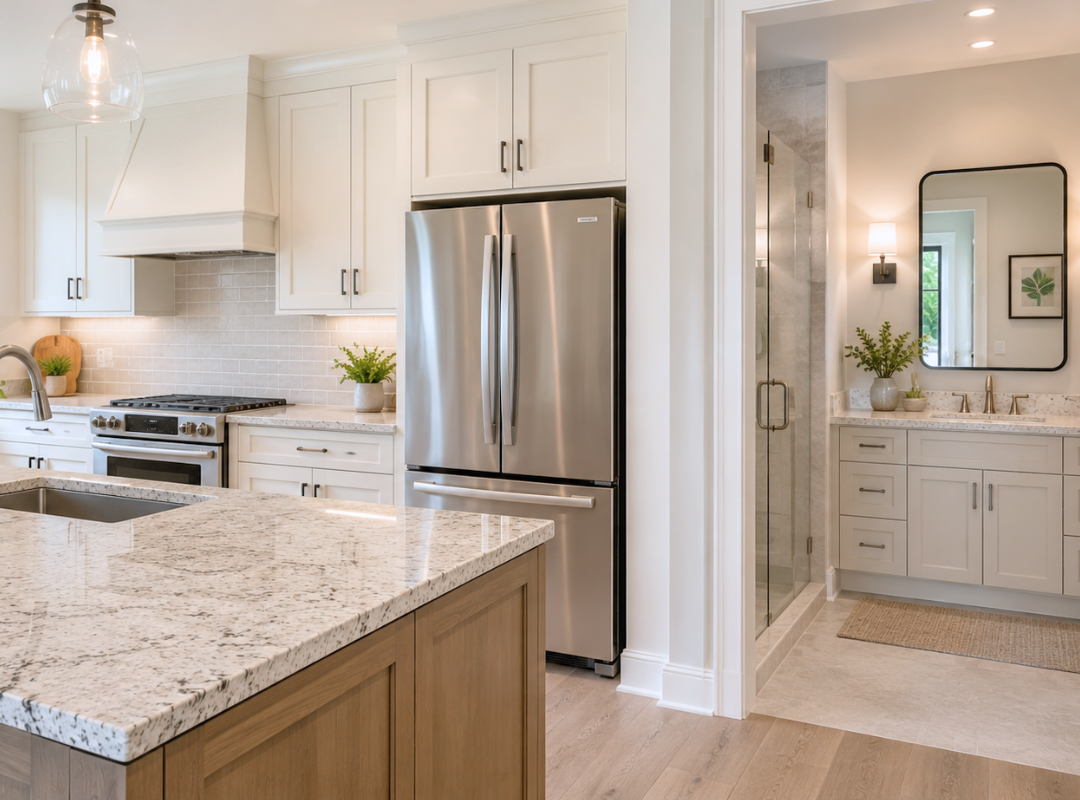
Granite Works and Stone Design | How Granite Transforms Florida Kitchens and Bathrooms
Granite works as a design surface because it is one of the few materials that combines extraordinary natural beauty with genuine, long-term performance. Every granite slab is geologically unique — shaped by millions of years of heat and pressure — and no two kitchen or bathroom installations look exactly the same. In Florida homes, where durability, humidity resistance, and aesthetic longevity all matter, granite is one of the most intelligent stone design choices available.
What Is Granite and Why Does It Work So Well as a Design Surface in Florida Homes?
Granite is an igneous rock formed when magma cools and crystallises slowly beneath the earth’s surface. The minerals that crystallise during this process — primarily quartz, feldspar, and mica — give granite its characteristic speckled appearance, its extraordinary hardness, and its natural resistance to heat, moisture, and physical wear. No two granite slabs are identical because the precise mineral composition and crystallisation pattern of each deposit is unique to its geological origin.
As a design surface, granite brings qualities that manufactured materials cannot replicate. The depth of colour in a granite slab — the way light plays through the translucent quartz crystals and reflects off the mica flecks — creates a visual richness that is genuinely three-dimensional. In a kitchen or bathroom, a granite countertop is not just a functional surface. It is the material that anchors the room and gives it its character. This is why granite has remained one of the most sought-after surfaces in residential interior design for decades, despite the arrival of numerous manufactured alternatives.
In Florida homes specifically, granite’s physical properties align exceptionally well with the demands of the climate. Granite is one of the densest natural stones, with very low porosity when properly sealed — meaning it resists moisture absorption in the high-humidity conditions that define Central Florida kitchens and bathrooms. Its thermal mass keeps it cool to the touch even in warm rooms. Its hardness — rating 6 to 7 on the Mohs scale — means it resists the scratching and chipping that daily kitchen use demands. And its long-term stability means that a properly installed and maintained granite surface in a Florida home today will still be performing at the same level in three or four decades.
The range of granite available to Florida homeowners has expanded significantly in recent years. Beyond the classic beige and brown granites that dominated the market in the 1990s and 2000s, there are now dramatic black granites from Zimbabwe and India, white and cream granites with bold veining that mimic the appearance of marble, deep blue and green granites from Brazil and Norway, and richly patterned exotic stones that function as centrepieces in their own right. Choosing among them requires an understanding of how each stone will perform in its specific application — and that understanding is exactly what Marilou brings to every Stones Design LLC project.
How Is Granite Used in Kitchen Design — From Countertops to Islands and Beyond?
The kitchen countertop is the most common application for granite in a Florida home, and with good reason. A granite kitchen countertop handles everything that daily cooking demands: hot pans placed directly from the hob, acidic ingredients, chopping, heavy appliances, and the sustained moisture exposure of a working kitchen. When correctly specified and sealed, it does all of this without damage, staining, or deterioration.
The kitchen island is where granite stone design has the greatest visual impact. A large island countertop — 1200mm to 2400mm or longer in many Florida kitchens — is a significant surface area, and a boldly patterned or richly coloured granite slab at this scale becomes the visual centrepiece of the whole kitchen. For island countertops, I always recommend selecting the actual slab in person at the stone yard before any cutting or fabrication begins. The pattern in a granite slab runs continuously from one end to the other, and the orientation of that pattern relative to the island dimensions makes an enormous difference to the finished result. This is not a decision that can be made from a 15cm sample chip.
Beyond countertops and islands, granite works beautifully as a kitchen splashback surface. A full-height granite splashback — running from the countertop to the underside of the overhead cabinetry — creates a material continuity between the horizontal and vertical surfaces of the kitchen that is architecturally powerful and extremely practical. Granite splashbacks are easy to clean, heat-resistant, and completely impermeable when sealed, making them one of the most functional as well as most beautiful choices in a Florida kitchen.
Granite also works for kitchen flooring, although it is less commonly specified in this application than for countertops. In a Florida home where the kitchen connects directly to an outdoor entertaining area or lanai, a granite floor that runs continuously from the kitchen through to the outdoor surface creates a seamless indoor-outdoor flow that is both visually striking and practically very functional. The key specification consideration for granite kitchen floors is finish: a honed or flamed finish provides better grip and shows less wear than a polished surface in a high-traffic cooking environment.
How Does Granite Work in Bathroom Design, Vanities, and Feature Surfaces?
Granite in bathroom design delivers a level of material richness and permanence that is difficult to achieve with any other stone. The bathroom is the room in a Florida home where the combination of humidity, moisture, and daily intensive use makes material quality most visible over time — and granite’s performance in those conditions is unmatched among natural stones at a comparable price point.
The vanity countertop is the most common bathroom application, and granite handles bathroom vanity conditions particularly well. Water pooling, mineral deposits from Florida’s hard water, cosmetics, cleaning products, and daily physical contact are all part of a bathroom vanity’s working environment. A sealed granite vanity countertop manages all of these without staining or surface damage, and its density means it does not absorb the moisture that penetrates and damages softer stone surfaces over time. For Florida bathrooms where hard water mineral deposits are a persistent issue, a honed or leathered granite finish is a practical choice — it shows water marks less readily than a polished finish while retaining all of the stone’s colour depth and character.
Granite feature walls in a bathroom are one of the most striking applications of stone design available. A floor-to-ceiling granite feature wall behind a freestanding bath, or a full granite surround in a walk-in shower, creates an environment that is genuinely spa-like in its material quality and visual impact. In these applications, I specify granite in a bookmatched configuration wherever the slab dimensions and budget allow — bookmatching involves cutting two consecutive slabs from the same block and opening them like the pages of a book so that the pattern mirrors across the join. The result is symmetrical, architectural, and visually extraordinary.
Granite also works extremely well as bathroom flooring, with the same finish specification rule that applies elsewhere: honed or flamed rather than polished for any floor surface that will be walked on when wet. In a master bathroom, running the same granite across the floor and into the shower creates a material continuity that makes the room feel significantly larger and more considered. This is one of the design moves that has the greatest impact for the investment, and it is something I discuss with every client planning a bathroom remodel at Stones Design LLC.
Granite selection for kitchens and bathrooms is one of the most consequential decisions in a Florida home renovation — and one where seeing the actual slabs in person makes all the difference. At Stones Design LLC, Marilou sources and selects every granite surface personally, ensuring that the stone specified is not just appropriate in principle but genuinely exceptional in the context of your specific home. Visit our natural stone and countertop services to find out how we work, or call 407-808-4011 to book a free consultation.
What Are the Different Granite Finishes and How Do They Affect the Design?
Granite is available in several surface finishes, each of which changes the stone’s visual character, tactile quality, and practical performance. Choosing the right finish for each application is as important as choosing the right granite colour or pattern — the same stone can feel completely different depending on how its surface has been treated.
Polished granite is the most familiar finish and the most widely used for kitchen countertops. The polishing process reveals the full depth of colour in the stone, brings out the brilliance of the mica crystals, and creates a smooth, reflective surface that is easy to clean and highly practical in a kitchen environment. In the right light, a polished granite countertop in a rich tonal stone — a dark green or deep burgundy granite, for example — has a jewel-like quality that no other finish achieves. The practical consideration is that polished granite does show fingerprints and water marks on very dark or very uniform stones, which is worth discussing before selection.
Honed granite has a matte or satin surface produced by stopping the polishing process before the reflective sheen develops. The result is a softer, more understated appearance that suits contemporary and transitional interiors particularly well. Honed granite reveals the stone’s colour accurately without the reflective intensity of the polished finish, and it is the preferred choice for bathroom vanities, bathroom floors, and any application where a more restrained aesthetic is appropriate. Honed granite is also more forgiving of fingerprints and minor surface marks than polished granite.
Leathered granite — sometimes called brushed granite — is produced by a diamond-tipped brush that opens the natural pores in the stone’s surface to create a gentle, tactile texture. The result has a depth of surface that neither polished nor honed finishes achieve: it feels alive under the hand, with a three-dimensional quality that reads beautifully in raking light. Leathered granite has become increasingly popular in Florida kitchen and bathroom design over the past decade because it combines the material richness of granite with a surface quality that is both highly distinctive and exceptionally practical — it hides fingerprints and water marks better than any other granite finish.
Flamed granite is produced by exposing the stone’s surface to an extremely high-temperature flame, which causes the surface minerals to expand and fracture into a rough, textured finish. It is used almost exclusively for exterior paving and flooring applications where maximum grip is required. In a Florida outdoor living area, poolside terrace, or approach path, flamed granite is one of the most durable and practical stone surfaces available — its texture provides excellent grip when wet, and its thermal stability means it does not heat to an uncomfortable temperature underfoot even in Florida’s direct summer sun.
How Does a Stone Design Professional Select and Specify Granite for a Florida Home?
Professional granite selection begins with understanding the specific conditions of the installation: the room’s light quality and direction, the surrounding materials and colours, the pattern and scale of the adjacent cabinetry or tile, and the daily use patterns of the household. Each of these factors narrows the field of appropriate granite choices before a single slab is viewed.
The next step is always visiting the stone yard in person. Granite slabs are large — typically 2.4 to 3.2 metres long and 1.5 to 1.8 metres wide — and they need to be seen at full scale, in natural light, alongside the other materials they will be paired with. Showroom sample chips are useful for initial orientation, but they cannot represent how a full slab’s pattern will read across a kitchen island or a bathroom feature wall. The variation within a single granite type — the movement and scale of the patterning, the balance of dark and light minerals, the clarity of the crystal structure — is enormous, and selecting from the actual available slabs rather than from a generic category is the difference between a result that is ‘nice’ and one that is genuinely exceptional.
Edge profile selection is a detail that significantly affects the finished character of a granite countertop. The edge profile — the shape given to the exposed edge of the slab after cutting — ranges from a simple straight or eased edge to an ogee or bullnose profile. For contemporary Florida kitchens, a clean straight or very slightly eased edge is the most design-appropriate choice: it allows the stone’s surface to be the focus rather than the edge detail. More decorative profiles can work well in traditional or transitional kitchen designs where the edge is a deliberate part of the kitchen’s architectural character.
Installation and sealing are the final, non-negotiable steps in a professional granite specification. Granite must be installed on a level, fully supported substrate — any flex in the surface beneath a granite slab will result in cracking over time. Joints between slabs need to be tight, aligned with the stone’s pattern wherever possible, and filled with a colour-matched epoxy adhesive. Professional sealing on installation protects the stone’s porosity from the outset and forms the foundation of the low-maintenance performance that makes granite such an intelligent long-term investment in a Florida home.
Frequently Asked Questions About Granite Works and Stone Design
How long does granite last as a countertop surface in a Florida home?
Granite countertops last decades — in most cases, the lifetime of the home itself. Granite is one of the hardest natural stones, rating 6 to 7 on the Mohs hardness scale, which makes it highly resistant to scratching, chipping, and heat damage. In Florida homes, sealed granite countertops handle the state’s humidity without warping, swelling, or deteriorating. With professional sealing on installation and resealing every two to three years, a granite countertop installed today will still be performing and looking exceptional in 30 or 40 years.
Does granite require a lot of maintenance in a Florida kitchen or bathroom?
Granite requires modest, straightforward maintenance rather than intensive care. It needs to be sealed professionally on installation to prevent staining and moisture penetration, and resealed every two to three years in a kitchen and every three to five years in a bathroom, depending on usage. Daily cleaning requires nothing more than a soft cloth and a pH-neutral stone cleaner — avoid acidic cleaners such as vinegar or citrus-based products, which can dull the surface over time. Beyond sealing and careful cleaning, granite is one of the most self-sufficient natural stone surfaces available.
What granite colours work best in a Florida kitchen interior?
The granite colours that work best in Florida kitchens depend on the cabinetry tone and the amount of natural light in the space. White and cream kitchens pair beautifully with granite in warm gold, soft beige, and brown tones — Giallo Ornamental, Santa Cecilia, and Venetian Gold are consistently popular choices in Central Florida. Dark cabinetry or two-tone kitchens benefit from dramatic black and dark grey granites such as Absolute Black, Black Pearl, and Nero Zimbabwe. For maximum visual impact, white and cream granites with strong veining — White Ice, Alaska White, and Colonial White — create a marble-like appearance at granite’s greater durability.
Can granite be used for bathroom floors as well as countertops?
Yes — granite is an excellent choice for bathroom flooring as well as vanity countertops and feature walls. Its density makes it one of the most moisture-resistant natural stones, which is important in a Florida bathroom where humidity levels are consistently high. For bathroom floors, specify granite in a honed or flamed finish rather than a polished finish — polished granite becomes slippery when wet and is not safe for floor applications. Honed granite retains all of the stone’s character and durability while providing adequate grip underfoot.
How do you match granite to other stone and tile surfaces in a home interior?
Matching granite to other surfaces in a home interior works best when you establish a tonal relationship rather than trying to achieve an exact match. Granite countertops do not need to replicate the floor tile or wall tile — they need to share a compatible colour temperature. Warm-toned granite pairs with warm-toned floor tiles and warm-toned wall colours. Cool-toned granite — grey, blue-grey, and charcoal — pairs with cooler floor materials and neutral wall tones. The key is selecting all surfaces together, in the actual light conditions of the room, before any material is purchased or installed.
Ready to bring the beauty and permanence of granite into your Florida home? Stones Design LLC’s natural stone and countertop service covers granite selection, sourcing, specification, and installation management for kitchens, bathrooms, and whole-home projects across Central Florida. Book a free consultation and let Marilou guide every granite and stone design decision from brief to beautiful finish — call 407-808-4011.