
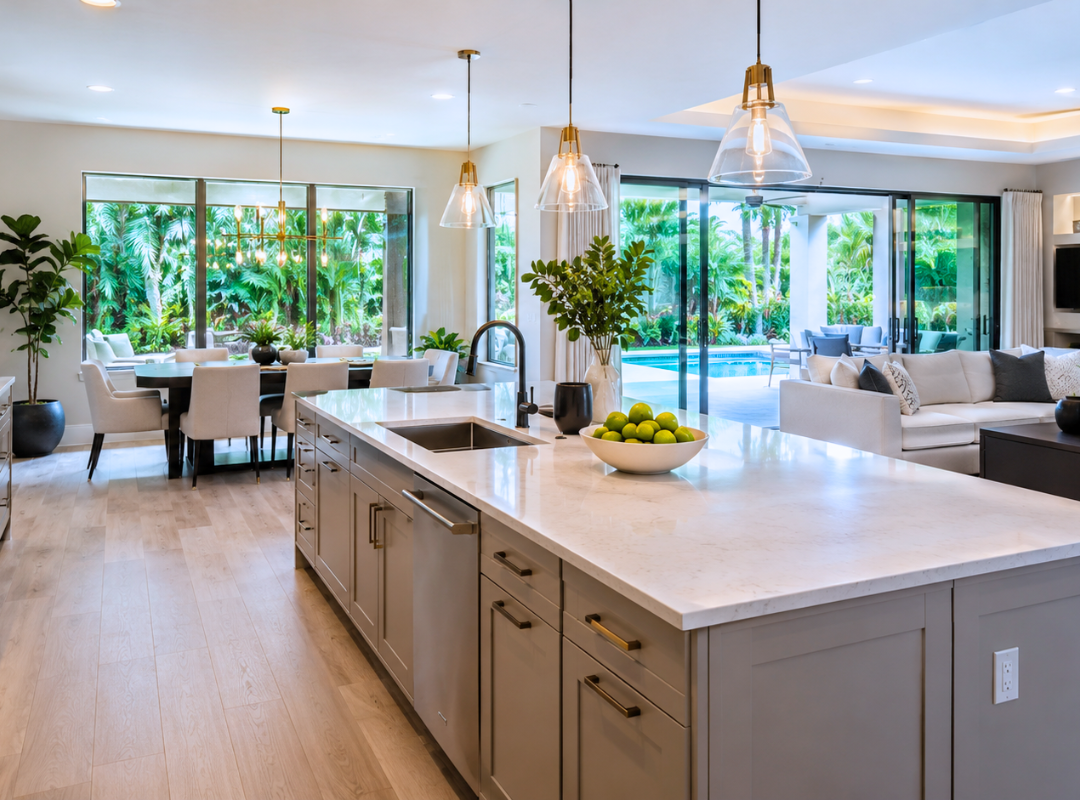
Open Concept Kitchen Ideas for Florida Living (2026)
Open concept kitchen ideas combine cooking, dining, and living areas into one connected space — using shared sightlines, a central island, and continuous flooring to make the kitchen the heart of the home. In Florida, open concept layouts also pull in natural light and outdoor views from lanais and patios. Here are the design ideas that work best in 2026.
What is an open concept kitchen?
An open concept kitchen is a kitchen with no full walls separating it from the dining or living area. Cooking, eating, and lounging share one continuous space, usually anchored by a central island that defines the kitchen zone.
The defining feature is sightlines. The cook can see and talk to anyone in the dining or living area. Natural light flows freely from one end of the room to the other. The visual connection makes even modest square footage feel generous.
Open concept does not mean unstructured. Good open concept design uses ceiling height, lighting, and material changes to give each zone a clear identity — without putting walls back in.
Why do open concept kitchens work so well in Florida homes?
Open concept kitchens work in Florida because they amplify two things every Florida homeowner wants: natural light and indoor-outdoor flow. Removing interior walls lets sunlight reach the centre of the home. Combine that with sliding glass doors to a lanai, and the kitchen becomes part of the outdoor living space too.
Florida lifestyle also fits the layout. Family gatherings, casual entertaining, and Sunday afternoons drifting between kitchen, lanai, and pool — all of it works better when the kitchen is open. The cook is never stuck in a separate room while everyone else is together.
The climate angle matters too. Cross-ventilation improves dramatically when interior walls are removed. In a well-designed open concept Florida home, the breeze from the lanai carries straight through to the front of the house.
What island layout works best in an open concept kitchen?
The single-run island with seating on the living room side is the most popular layout in 2026. It puts the cooktop or sink on the back wall, keeps prep space facing the cook, and turns the island’s outer edge into a casual seating bar. Family and guests can chat without standing in the workflow.
For larger Florida kitchens, a double island layout is gaining ground. One island handles prep and cooking; the second handles seating, serving, and casual meals. The double layout gives clear separation of work and social zones — useful in homes that entertain often.
Whatever layout you choose, the rule is the same: 42 to 48 inches of clearance on every side. Less than that and the island feels cramped. More than 60 inches and the cook is taking too many steps between work zones.
How do you define zones without losing the open feel?
The best open concept kitchens use four tools to define zones without walls: ceiling treatments, lighting, flooring transitions, and material breaks. A coffered or tray ceiling above the dining area signals ‘this is the dining zone’ without enclosing it. Pendant lights over the island do the same for the kitchen.
Flooring is the most underused tool. Running the same large-format porcelain through kitchen, dining, and living areas keeps the space feeling unified. Switching to wood-look plank in the living zone — with a clean transition strip — adds warmth where you sit and keeps tile where it works hardest.
Subtle material breaks finish the job. A different cabinet finish on the island compared to the perimeter cabinets. A feature wall behind the dining zone. A change of paint colour above a wainscot line. Each one signals ‘different zone’ without adding a single wall.
This is where working with an experienced interior designer makes the real difference. At Stones Design LLC, Marilou plans every zone, every sightline, and every material transition before a wall comes down — so the finished kitchen feels open and intentional, not just empty. Visit kitchen design service in Orlando or book a free consultation — call us on 407-808-4011.
Which materials and finishes hold up best in a Florida open concept kitchen?
Three material categories carry the weight in a Florida open concept kitchen: countertops, flooring, and cabinetry. Quartz countertops lead the field for durability — non-porous, heat-resistant, and unaffected by humidity. For a more natural look, quartzite holds up almost as well as quartz and reads like real stone.
Large-format porcelain tile is the flooring workhorse. It handles the kitchen’s wear and water exposure, then continues seamlessly into the living area. Luxury vinyl plank is the strong runner-up — softer underfoot and warmer in tone, though slightly less durable around heavy appliance traffic.
For cabinetry, choose moisture-resistant box construction with painted or thermofoil door fronts. Solid wood doors swell and contract with Florida humidity unless they’re top-tier construction. Two-tone schemes — light perimeter cabinets with a deeper island colour — are the dominant look in 2026 open concept Florida kitchens.
Frequently Asked Questions About Open Concept Kitchen Ideas
Are open concept kitchens still in style in 2026?
Yes — open concept kitchens remain the most requested layout in Florida new builds and remodels in 2026. The trend has matured, with designers now adding subtle zoning through ceiling treatments, lighting, and flooring transitions rather than reverting to closed-off rooms. The open feel stays; the structure gets smarter.
How big should an island be in an open concept kitchen?
An island in an open concept kitchen should be at least 4 feet by 7 feet to function comfortably for both prep and seating. For islands with seating on one side, allow 24 inches of width per stool. Keep at least 42 to 48 inches of clearance on every side for traffic flow and appliance doors.
What is the downside of an open concept kitchen?
The main downsides of an open concept kitchen are noise, cooking smells, and constant visibility of mess. Florida homeowners solve these with a strong range hood (600 CFM minimum), a hidden prep pantry behind the main kitchen, and durable materials that look intentional even when the kitchen is in use.
Should the kitchen island face the living room or the kitchen?
The island should face the living room when the cook wants to interact with family or guests during prep. The cooktop and sink stay on the back wall or the long side of the island, while the seating side faces outward. This keeps the workspace tidy and the social side welcoming.
What flooring works best for an open concept kitchen in Florida?
Large-format porcelain tile and luxury vinyl plank are the two best flooring choices for open concept kitchens in Florida. Both handle humidity well, transition seamlessly from kitchen to living areas, and resist water damage near the sink. Engineered hardwood is a strong third option in climate-controlled homes.
Want to keep reading?
If open layouts are on your radar, two related guides will help: why Orlando designers love open floor plans and smart design tips for open concept homes in Florida.
Ready to design your open concept kitchen?
Ready to open up the heart of your Florida home? At Stones Design LLC, Marilou plans every layout, material, and zone before a wall comes down — so the finished space feels open, calm, and built for how you actually live. Explore our kitchen design service in Orlando or book a free consultation — and let’s bring your vision to life. We’ll make sure your kitchen reflects who you are and works the way you need it to.