
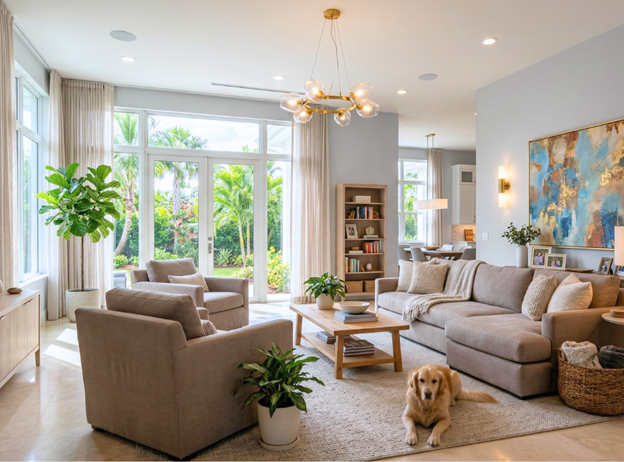
How to layer lighting in a room that already gets intense Florida sunlight?
By Marilou Stones — Award-winning Interior Designer, Orlando, FL
Best Interior Designer — Winter Garden Magazine 2024
Good Stuff Awards 2024 | Parade of Homes Realtors Favorite 2025
Use dimmable recessed lighting, task lamps, and accent lighting on a three-circuit lighting design to adapt to Florida’s changing daylight. Add smart dimmers for flexibility and LED lighting in a Florida interior to maintain comfort, reduce glare, and create balanced lighting from morning to evening.
The real lighting challenge in Florida homes
In Central Florida, most living rooms do not need more daylight—they need better control.
The biggest mistake I see is assuming natural sunlight replaces artificial lighting. It does not. Light shifts dramatically throughout the day, especially in homes with large east- or west-facing windows.
At 9 a.m., the room feels bright and open. By late afternoon, glare becomes an issue. By evening, the same space can feel flat and underlit.
That is exactly where a layered lighting Florida home approach becomes essential.
Instead of competing with sunlight, the goal is to support it—creating a space that feels comfortable, functional, and visually balanced from morning through night.
My go-to solution: a three-circuit lighting design
If you want lighting that works in a bright Florida living room, I strongly recommend a three-circuit lighting design. It is one of the most effective ways to create flexibility without overcomplicating space.
Here is how I structure it:
1. Ambient lighting (foundation layer)
I use recessed LED downlights to create even illumination across the room. In most projects, I install them on smart dimmers for Florida rooms where daylight shifts constantly.
This allows you to soften brightness during peak sun hours and increase it when natural light fades.
2. Task lighting (functional layer)
This includes floor lamps, reading lights, and directional fixtures placed exactly where you need them.
Task lighting becomes especially important in a living room modern design, where clean layouts often rely on intentional lighting rather than overhead fixtures alone.
3. Accent lighting (depth + atmosphere)
This is where LED lighting in a Florida interior makes the biggest difference.
I often install LED strips under shelves, inside built-ins, or behind feature walls. These subtle layers add dimension, reduce contrast, and make the room feel finished after sunset.
Why smart dimmers change everything
Lighting in Florida is not static—so your controls should not be either.
Using a smart dimmer in Florida room environments allows you to adjust lighting levels throughout the day without switching between multiple fixtures.
I typically recommend systems like Lutron Caséta or RadioRA 3 because they simplify control while maintaining a clean, uncluttered look.
This small upgrade dramatically improves how a room feels and functions.
Where this works best in real homes
I see the biggest transformation in living rooms with large sliding doors, lanais, or pool-facing windows—common throughout Orlando, Winter Garden, and surrounding areas.
Without proper layering, these spaces often feel:
- Too bright during the day
- Uneven in the afternoon
- Flat and underwhelming at night
With the right lighting structure in place, everything shifts:
- Daylight feels softer and more controlled
- Evenings feel warm and intentional
- The room works consistently at every hour
Simple upgrades you can make right now
You do not need a full renovation to improve your lighting.
Here are practical upgrades I regularly recommend:
- Install smart dimmers for Florida rooms to improve flexibility
- Add LED strip lighting to shelves or built-ins
- Use warm 2700K–3000K bulbs for evening comfort
- Replace outdated recessed bulbs with dimmable LED options
These changes are cost-effective but make a noticeable difference in how your space looks and feels.
How lighting supports modern living room design
Lighting does not work in isolation—it shapes the entire experience of a room.
In a living room modern design, lighting defines:
- Visual balance
- Mood and comfort
- How the space transitions from day to night
When layered correctly, lighting elevates everything else in the room—from furniture to finishes—without adding clutter or complexity.
When to consider a professional lighting plan
If your living room feels too bright during the day and too dim at night, that is a clear sign your lighting is not working as it should.
This is one of the most common issues I solve in Central Florida homes.
A well-planned lighting strategy does not just improve visibility—it completely transforms how your home feels to live in.
If you are ready to see what a tailored lighting plan could do for your space, start here:
https://www.stonesdesignllc.com/contact/
FAQs
Do I need layered lighting in a Florida home if I already have large windows?
Yes. Large windows create changing light conditions throughout the day. Layered lighting ensures your space remains comfortable and functional from morning to evening.
What is a three-circuit lighting design?
A three-circuit lighting design separates ambient, task, and accent lighting, so each layer can be controlled independently for better flexibility and balance.
Is LED lighting in a Florida interior better than traditional bulbs?
Yes. LED lighting produces less heat, lasts longer, and works seamlessly with smart dimmers, making it ideal for Florida homes.
Why should I use a smart dimmer in a Florida room?
A smart dimmer allows you to adjust lighting levels as natural light changes throughout the day, improving comfort and reducing glare.
What color temperature works best for a modern Florida living room?
A range of 2700K–3000K works best. It provides warm, comfortable lighting in the evening while still feeling bright and clean during the day.