
How to Choose the Perfect Light Fitting for Your Dining Room
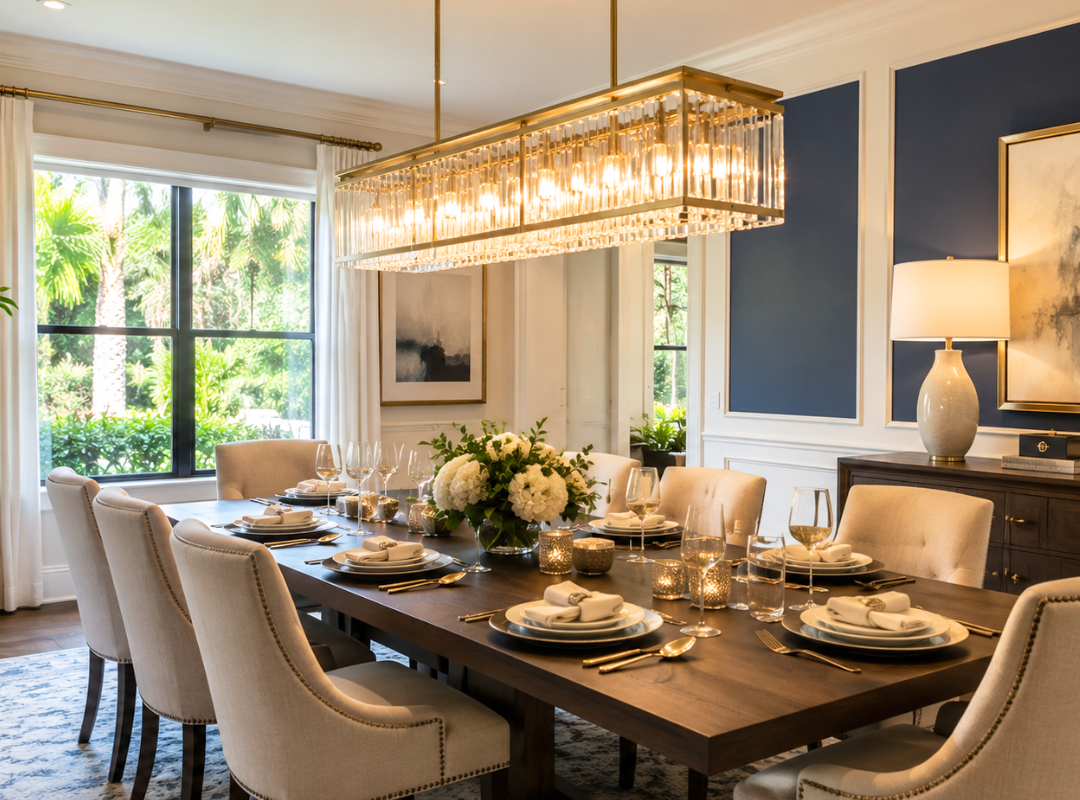
The right light fitting for a dining room is the one that matches the ceiling height, table size, and design style of the space. A chandelier or pendant hung 30–36 inches above the table surface creates the ideal combination of ambient and focused light. The fitting should be roughly half the table width for balanced proportions. Get those three measurements right, and the rest of your lighting choices become straightforward.
What type of light fitting works best in a dining room?
A chandelier or large pendant is the most effective light fitting for a dining room. Both create a defined focal point, direct light onto the table surface, and add a layer of design that complements the room’s overall aesthetic.
Chandeliers work well in formal or traditional dining rooms, particularly where ceiling height allows. A flush or semi-flush fitting suits lower ceilings — typically anything under 8 feet. Pendants are more versatile: a single large drum pendant works over a round table, while three smaller pendants in a row suit a rectangular table in an open-plan kitchen-dining space.
Track lighting and recessed downlights work as supplementary sources but should never be the main fitting over the table. They flatten the light and remove the sense of occasion that a well-chosen central fixture creates. For a Florida dining room that shifts from weekday family meals to weekend entertaining, a chandelier or pendant on a dimmer gives you the most flexibility.
How low should a dining room light fitting hang?
A dining room light fitting should hang 30–36 inches above the table surface. That range puts the light close enough to illuminate the table clearly without restricting sightlines across it.
If your ceiling is higher than 8 feet, add 3 inches for every additional foot. A 10-foot ceiling means your fitting should hang 36–42 inches above the table. A 12-foot ceiling gives you 42–48 inches. In open-plan spaces where the dining area connects to a living or kitchen zone, the bottom of the fitting should also clear seated eye level — typically around 60–66 inches from the floor.
Always measure from the table surface, not the floor. The floor-to-fitting height is a secondary consideration. The primary relationship is between the fitting and the table — that is the interaction that matters for how the room feels when people are sitting at it.
How do you choose the right size chandelier or pendant for a dining room?
A dining room chandelier should be roughly half the width of your dining table. For a 60-inch table, that means a fixture around 28–32 inches wide. For a 72-inch table, aim for 34–38 inches.
There is a second rule of thumb that works well for the overall room: add the length and width of the room in feet. The total in inches gives you the ideal fixture diameter. A 12 x 14 foot dining room suggests a 26-inch fixture. A 14 x 16 room suggests 30 inches. Use whichever calculation produces the larger number — that accounts for visual weight relative to both the table and the full room.
In Florida dining rooms, proportion matters especially because of the open floor plans common in Central Florida homes. A fitting that looks right in a traditional enclosed room can look undersized when the dining area flows into a living space. When in doubt, go slightly larger — a fitting that reads as slightly bold is always better than one that disappears into the ceiling.
Choosing the right fitting size is where professional guidance pays off — small measurement errors create proportional problems that are hard to undo once the fitting is in. At Stones Design LLC, Marilou selects and coordinates lighting as part of every dining room design — taking into account ceiling height, table dimensions, and the full room aesthetic. Visit our dining room lighting tips page or book a free consultation — call us on 407-808-4011.
What lighting style suits a Florida dining room?
Florida dining rooms suit fittings with natural materials, lighter finishes, and open silhouettes. Rattan, woven grass, bleached wood, brushed brass, and matte black all work well in the Central Florida design context — they feel relaxed without being casual, and they complement the natural light that Florida homes are built around.
Heavy crystal chandeliers and ornate iron fixtures can work in formal dining rooms with high ceilings, but they are rarely the right choice for the open-plan, light-filled spaces that define Orlando-area homes. The fixture should complement the room’s natural light — not compete with it.
Coastal and transitional styles are the dominant aesthetic in Windermere, Winter Park, and Dr. Phillips homes. For these, a drum pendant in a natural linen shade, a woven rattan globe, or a simple brushed gold ring chandelier all add warmth without weight. Marilou’s approach is always to find the fitting that looks like it belongs in the home — not a piece that was imported from a different design world entirely.
Can you mix different light fittings in a dining room?
Yes — layering light sources in a dining room is good design practice, not a compromise. The central chandelier or pendant provides the primary source and the focal point. Supplementary lighting fills in the rest of the room.
Wall sconces on a dining room sideboard wall create a warm secondary layer and add depth when the overhead light is dimmed. A low console lamp adds intimacy for evening dining. Recessed downlights on a separate circuit allow you to light artwork or a feature wall independently from the table.
The rule is to keep the central fitting visually dominant. Everything else should feel like a supporting player. Mixing metals is acceptable — brushed brass and matte black work well together — but limit your palette to two finishes across the whole room. More than that and the space starts to feel unresolved. For a dining room that doubles as an entertaining space, a layered lighting scheme is one of the single highest-impact investments you can make.
Related reading:
Dining room light fitting ideas for Florida homes | How to choose the perfect light fitting for a dining room makeover
Frequently Asked Questions About Light Fittings for the Dining Room
What is the best light fitting for a dining room?
The best dining room light fitting is a chandelier or large pendant centred over the dining table. It should hang 30–36 inches above the table, cover roughly half the table width, and sit on a dimmer switch so you can adjust the mood for different occasions.
How high should a dining room light fitting be from the table?
A dining room light fitting should hang 30–36 inches above the table surface. In rooms with ceilings higher than 8 feet, add 3 inches for every additional foot of ceiling height. Too low and it blocks sightlines; too high and it loses its impact as a focal point.
What size chandelier do I need for my dining room?
A dining room chandelier should be roughly half the width of your dining table. For a 60-inch table, choose a fixture around 30 inches wide. Alternatively, add the room’s length and width in feet — the sum in inches gives you the ideal fixture diameter.
What lighting style works in a Florida dining room?
Florida dining rooms suit light fittings with natural materials — rattan, woven grass, weathered metal, or light-toned wood. These textures complement the relaxed, coastal-influenced aesthetic common in Central Florida homes. Avoid heavy ornate chandeliers — they can make a bright, open Florida dining room feel too formal.
Should a dining room light fitting be on a dimmer?
Yes — every dining room light fitting should be on a dimmer switch. Dining rooms serve multiple purposes: bright for family meals, softer for dinner parties, and warmer for evenings. A dimmer gives you that range without changing the fitting. It is one of the simplest upgrades that delivers the biggest shift in atmosphere.
Ready to transform your dining room lighting? At Stones Design LLC, Marilou selects and coordinates lighting as part of every full dining room design — from fitting size and height to finish, layering, and dimmer configuration. Visit our dining room lighting tips page, or book a free consultation — call us on 407-808-4011 and let’s design a dining room that works beautifully for how you live.